Controls & Operations
Building automation engineering that makes mechanical systems measurable, controllable, and accountable—especially in facilities that cannot afford guesswork.
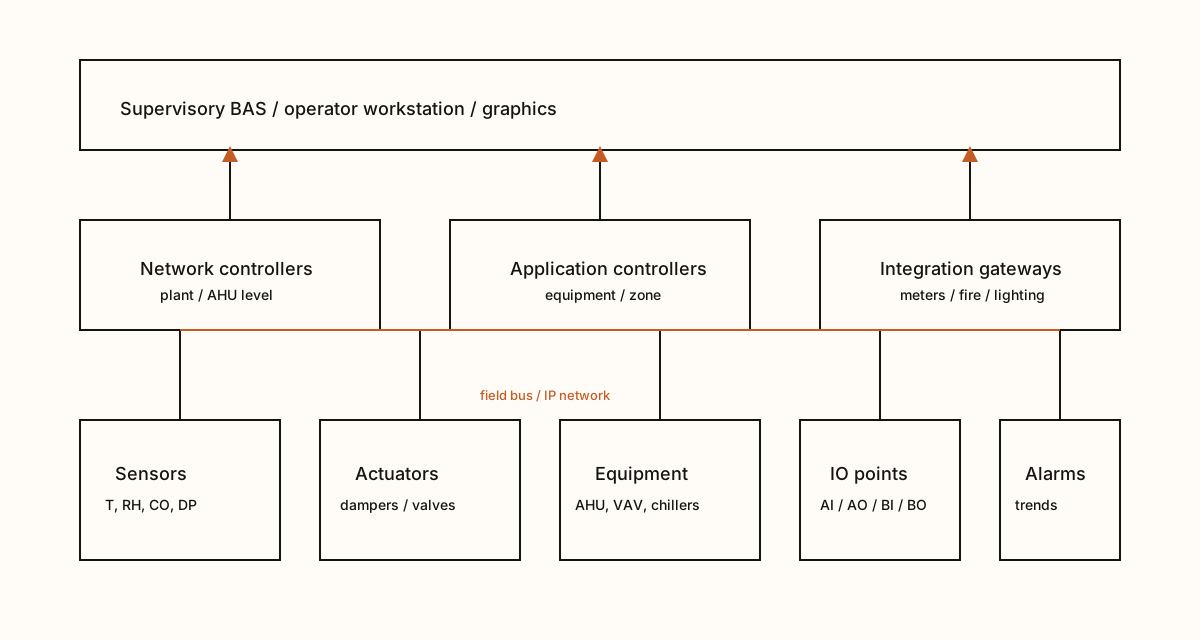
Building automation is the control layer that turns mechanical equipment into an operable system. Without documented sequences, trending, and alarm strategy, even well-designed HVAC plants drift. Indian River Mechanical Engineering treats building automation as an engineering discipline: points lists, sequences of operation, integration with air-side and plant equipment, and coordination with facility staff. On the Space Coast, automation is particularly important because humidity, occupancy, and process loads change quickly. A clinic, school, or manufacturing building that looks fine on a design-day calculation can still fail if dampers, valves, and setpoints are not controlled as intended.
Overview
What building automation engineering is
Engineering of building automation and HVAC controls for commercial, institutional, and industrial facilities, including sequences of operation, system integration, and optimization of existing BAS platforms.
Applications
What we actually do
New construction BAS design
Controls architecture, sequences, and specification language coordinated with HVAC equipment and electrical systems.
Existing-system optimization
Review of installed BAS graphics, trends, and sequences to correct simultaneous heating/cooling, poor dehumidification, or unused capabilities.
Plant and air-side integration
Connecting chillers, boilers, pumps, air handlers, VAV boxes, and lighting or metering where it supports operations.
Owner standards and campus systems
Helping institutions specify platforms, naming conventions, and graphics that staff can actually use.
Systems
Systems and solutions
Direct digital control (DDC)
Networked controllers for air handlers, plants, and terminal units.
Sequences of operation
Written logic for occupied/unoccupied modes, humidity control, economizer, demand control ventilation, and plant staging.
Supervisory platforms
Front-end systems used by facility managers for alarms, trends, and setpoint management.
Metering and analytics-ready points
Instrumentation that supports energy tracking and fault detection without turning the project into a software experiment.
Buildings
Building types
- Healthcare campuses and medical office buildings
- K-12 and higher-education facilities
- Government and municipal buildings
- Commercial offices and mixed-use
- Industrial and aerospace facilities with process HVAC
Problems
Problems this service solves
Systems that never run as designed
Occupied mode, night setback, or humidity sequences that were never commissioned or were overwritten in the field.
High energy use with no operational visibility
Plants that stage poorly, valves that hunt, or outdoor-air dampers that stay open.
Alarm noise and unused graphics
Front ends that staff ignore because they are cluttered, unnamed, or disconnected from real equipment.
Retrofits that leave controls behind
New equipment installed on old thermostats or fragmented vendor islands.
Engineering
Engineering considerations
- Sequences should be written in engineering language, not left to vendor defaults.
- Humidity and outdoor-air control are first-order problems in ASHRAE climate zone 2A, not optional extras.
- Points should be specified for operations and commissioning, not only for first-cost graphics.
- Cybersecurity, network architecture, and owner IT standards belong in the design conversation early.
- A BAS is only as useful as the training and documentation left with the facility team.
Related services
- Air Conditioning
Engineering of commercial and institutional air-conditioning systems for cooling, humidity control, and occupant comfort in Brevard County buildings.
- Chilled Water
Chilled-water system engineering for commercial and institutional cooling plants, distribution, and air-handling on the Space Coast.
- Central Plants
Engineering of central heating and cooling plants for campuses, healthcare, and larger commercial facilities on the Space Coast.
- Ventilation
Commercial ventilation engineering: outdoor air, exhaust, pressurization, and distribution for Brevard County buildings that must bring in humid air without losing control of the interior.
- Indoor Air Quality
Indoor air quality engineering for commercial and institutional buildings: ventilation, filtration, humidity, and contaminant control grounded in mechanical systems—not consumer purifiers.
- Thermal Storage
Thermal energy storage engineering that shifts cooling production in time, reducing peak demand on Space Coast chilled-water plants.
Locations
This service is available across Brevard County and the Orlando / Central Florida market. Place pages and approved service-location combinations are linked below.
- Building Automation context in Melbourne, FL
- Building Automation context in Palm Bay, FL
- Building Automation context in Viera, FL
- Building Automation context in Rockledge, FL
- Building Automation context in Cocoa, FL
- Building Automation context in Titusville, FL
- Building Automation context in Orlando, FL
- Building Automation context in Lake Nona, FL
- Building Automation context in Lake Mary, FL
- Building Automation context in Winter Park, FL
- Building Automation context in Winter Garden, FL
- Building Automation context in Kissimmee, FL
- Building Automation context in Sanford, FL
Questions
Building Automation FAQs
What is building automation in a mechanical engineering context?
It is the engineered control of HVAC and related building systems using sensors, controllers, sequences of operation, and a supervisory interface. It is not the same as a programmable thermostat or a consumer smart-home platform.
What does a mechanical engineer do related to building automation?
The engineer defines control intent, writes sequences, specifies points and integration requirements, reviews submittals, and supports commissioning so the installed system matches the mechanical design.
When is a building automation system needed?
Whenever a facility has multiple zones, a central plant, ventilation and humidity requirements, after-hours operation, or an owner who needs alarms and trending. Most commercial, healthcare, education, and government buildings benefit from engineered BAS.
How does building automation interact with other mechanical systems?
Automation is the operating brain of air conditioning, chilled water, heating, ventilation, and thermal storage. Equipment selection without control sequences leaves performance to chance.
What should a building owner consider before a BAS upgrade?
Owner standards, existing controller infrastructure, staff capabilities, cybersecurity, and whether the goal is replacement, expansion, or sequence correction. Upgrading graphics without fixing sequences rarely solves comfort or energy problems.
Discuss your project with an engineer.
Tell us about the building, the system, and the constraint. We will follow up with the right next step—not a sales script.