Indoor Environmental Quality
Indoor air quality engineering that starts with ventilation, filtration, and humidity—the systems that actually determine what people breathe in a building.
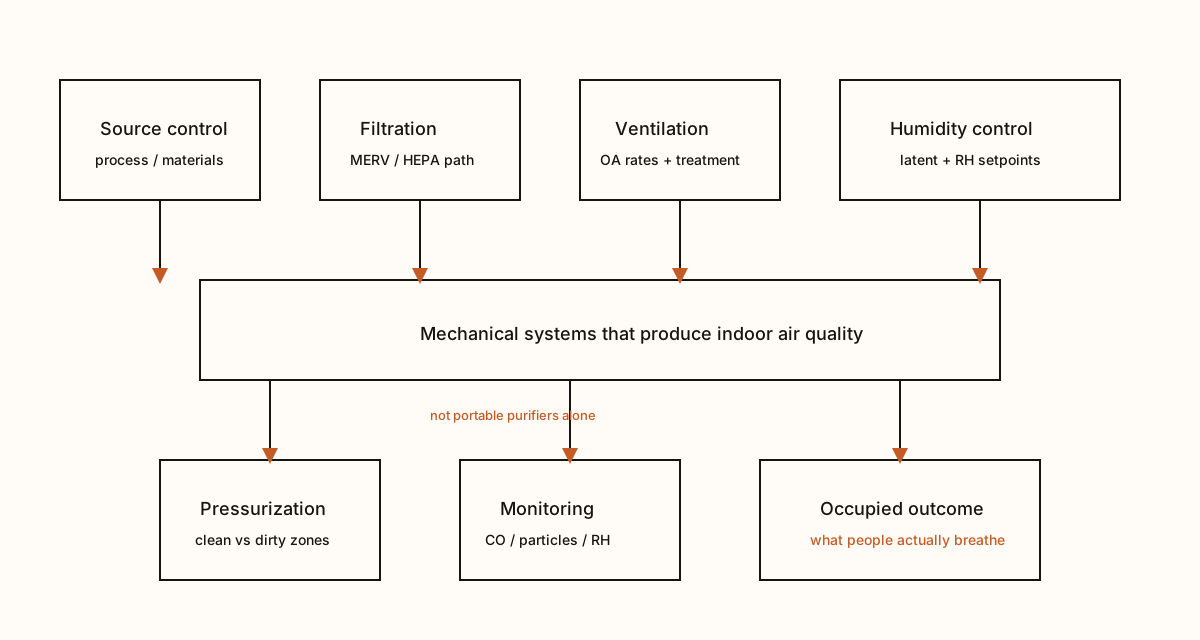
Indoor air quality in commercial buildings is produced by mechanical systems and the envelope, not by a portable device in a corner. Outdoor air quantity and treatment, filtration, humidity, pressurization, and pollutant sources all interact. Indian River Mechanical Engineering approaches IAQ as an engineering brief: what contaminants matter, what ventilation standard applies, what the existing system can do, and what changes are justified. After years of heightened attention to indoor air, owners still need designs that are maintainable and code-aligned, especially in schools, clinics, and civic buildings across Brevard County.
Overview
What indoor air quality engineering is
Engineering of indoor air quality strategies through ventilation, filtration, humidity control, pressurization, and source control for commercial, healthcare, education, and government facilities.
Applications
What we actually do
Ventilation and filtration upgrades
Evaluating outdoor-air rates, filter MERV, and whether air handlers can accept higher-efficiency filters.
IAQ assessments of existing buildings
Connecting complaints or measurements to mechanical causes: ventilation, humidity, or distribution.
Healthcare and education environments
Spaces with specific ventilation, pressure, and filtration expectations.
Renovation of older commercial stock
Common in Cocoa, downtown Melbourne, and other established districts where systems predate current IAQ practice.
Systems
Systems and solutions
Mechanical ventilation
Outdoor-air systems sized and controlled for occupancy and space type.
Filtration and air cleaning
Filter racks, pressure-drop budgets, and where additional air cleaning is actually warranted.
Humidity and temperature control
Moisture control as a foundation of perceived air quality and microbial risk.
Local exhaust and source control
Restrooms, kitchens, labs, shops, and process areas that should not share air with occupancy.
Buildings
Building types
- K-12 and higher education
- Healthcare and outpatient
- Offices and civic buildings
- Hospitality
- Multifamily common areas and amenity spaces
Problems
Problems this service solves
Stale air and occupant complaints
Insufficient outdoor air, poor distribution, or disabled ventilation to save energy.
Filters that the unit cannot support
High-MERV upgrades that starve airflow because fans and racks were never designed for them.
Odors migrating between spaces
Pressure relationships and exhaust that were never engineered.
Humidity-driven air quality problems
Biological growth and odor that look like an IAQ mystery until moisture is measured.
Engineering
Engineering considerations
- IAQ improvements that ignore fan capacity, coil performance, and humidity often make comfort worse.
- Ventilation effectiveness depends on distribution, not only on a calculated outdoor-air cfm.
- Healthcare and education have distinct standards; office rules should not be copied onto a clinic.
- Outdoor air on the Space Coast must be dehumidified; more ventilation without treatment is not automatically healthier.
- Measurement and verification belong in the project, or the upgrade will be undone in the first energy-saving season.
Related services
- Ventilation
Commercial ventilation engineering: outdoor air, exhaust, pressurization, and distribution for Brevard County buildings that must bring in humid air without losing control of the interior.
- Humidity Management
Humidity management engineering for commercial buildings in Brevard County’s hot-humid climate, where moisture control is a design problem, not a thermostat setting.
- Air Conditioning
Engineering of commercial and institutional air-conditioning systems for cooling, humidity control, and occupant comfort in Brevard County buildings.
- Building Automation
Building automation engineering that connects HVAC equipment, sensors, and sequences so Space Coast facilities operate as designed.
- Heating
Commercial heating engineering for Space Coast buildings that still need reliable heat, reheat, and domestic-related mechanical coordination despite a cooling-dominated climate.
Locations
This service is available across Brevard County and the Orlando / Central Florida market. Place pages and approved service-location combinations are linked below.
- Indoor Air Quality context in Melbourne, FL
- Indoor Air Quality context in Palm Bay, FL
- Indoor Air Quality context in Viera, FL
- Indoor Air Quality context in Rockledge, FL
- Indoor Air Quality context in Cocoa, FL
- Indoor Air Quality context in Titusville, FL
- Indoor Air Quality context in Orlando, FL
- Indoor Air Quality context in Lake Nona, FL
- Indoor Air Quality context in Lake Mary, FL
- Indoor Air Quality context in Winter Park, FL
- Indoor Air Quality context in Winter Garden, FL
- Indoor Air Quality context in Kissimmee, FL
- Indoor Air Quality context in Sanford, FL
Questions
Indoor Air Quality FAQs
What is indoor air quality engineering?
It is the use of ventilation, filtration, humidity control, pressurization, and source control to achieve indoor air that meets the building’s occupancy, code, and owner requirements.
What does a mechanical engineer do related to IAQ?
The engineer determines ventilation rates, filter strategies, exhaust and pressure relationships, and how those requirements fit the HVAC system’s capacity and controls.
When does a commercial building need IAQ engineering?
When occupancy changes, when complaints persist, when a renovation affects ventilation, or when the building type (school, clinic, civic) has specific indoor air expectations.
How does IAQ interact with ventilation and humidity?
Ventilation brings outdoor air that must be cleaned and dehumidified. Humidity that is too high undermines both perceived air quality and building materials. The three cannot be designed separately on the Space Coast.
Should every building add air cleaners?
Not automatically. Filtration and ventilation should be engineered first. Additional air cleaning is a targeted tool, not a substitute for outdoor air treatment and moisture control.
Discuss your project with an engineer.
Tell us about the building, the system, and the constraint. We will follow up with the right next step—not a sales script.