Load Shifting & Plant Optimization
Thermal storage engineering for owners who want cooling capacity and lower peak electrical demand without simply installing another chiller.
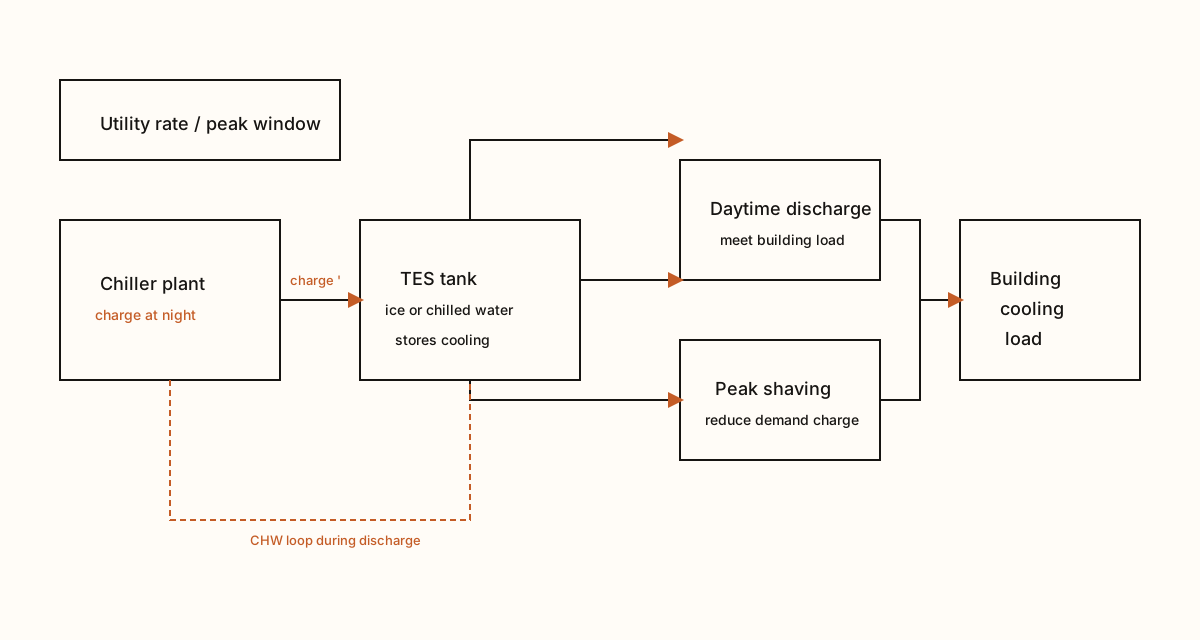
Thermal storage makes cooling when it is cheaper or more available and uses it later. In commercial buildings this is usually chilled-water tanks or ice storage integrated with a chiller plant. It is a planning and controls problem as much as a tank problem. Indian River Mechanical Engineering evaluates thermal storage when peak electrical demand, limited electrical service, nighttime production, or resilience justifies it. On the Space Coast, cooling loads persist for much of the year, so storage can be useful—but only if the plant, tank, and sequences are designed together. A tank without a dispatch strategy is just a large vessel in the yard.
Overview
What thermal storage engineering is
Engineering of chilled-water and ice thermal storage systems, including tank sizing, plant integration, control strategy, and evaluation of utility demand charges.
Applications
What we actually do
Peak-demand reduction
Shifting chiller operation off the utility peak to manage demand charges.
Deferred plant expansion
Using stored cooling to cover short peaks instead of adding immediate chiller capacity.
Resilience and operational flexibility
Providing a buffer when a chiller is down or electrical capacity is constrained.
Campus and healthcare plants
Integrating storage with existing chilled-water distribution.
Systems
Systems and solutions
Chilled-water stratified tanks
Sensible storage using temperature-stratified water, common for larger plants.
Ice storage
Latent storage that can provide lower water temperatures for dehumidification, with different plant implications.
Partial versus full storage
Operating strategies that either shave the peak or shift the entire cooling load.
Controls and dispatch
BAS sequences that charge and discharge storage against occupancy, weather, and utility rates.
Buildings
Building types
- Hospitals and medical campuses
- Higher-education campuses
- Large commercial developments
- Industrial facilities with high peak cooling
- Government complexes
Problems
Problems this service solves
Electrical service that cannot support another chiller
Storage can cover peaks when adding electrical capacity is slow or expensive.
High demand charges
A plant that runs hardest during the utility peak.
Short-duration cooling spikes
Assembly, process, or solar-driven peaks that do not justify full additional chiller capacity.
Engineering
Engineering considerations
- Storage only pays if there is a real peak-to-off-peak difference in cost, capacity, or risk.
- Tank volume, water temperatures, and mixing control determine usable capacity—not just gallons.
- Ice storage changes chiller operating temperatures and may help latent cooling, at a cost in compressor energy.
- Dispatch sequences must be commissioned; otherwise operators leave the tank isolated.
- Siting, structural loads, and hurricane criteria apply to outdoor tanks as they do to other plant equipment.
Related services
- Chilled Water
Chilled-water system engineering for commercial and institutional cooling plants, distribution, and air-handling on the Space Coast.
- Central Plants
Engineering of central heating and cooling plants for campuses, healthcare, and larger commercial facilities on the Space Coast.
- Building Automation
Building automation engineering that connects HVAC equipment, sensors, and sequences so Space Coast facilities operate as designed.
- Air Conditioning
Engineering of commercial and institutional air-conditioning systems for cooling, humidity control, and occupant comfort in Brevard County buildings.
- Heating
Commercial heating engineering for Space Coast buildings that still need reliable heat, reheat, and domestic-related mechanical coordination despite a cooling-dominated climate.
Locations
This service is available across Brevard County and the Orlando / Central Florida market. Place pages and approved service-location combinations are linked below.
- Thermal Storage context in Melbourne, FL
- Thermal Storage context in Palm Bay, FL
- Thermal Storage context in Viera, FL
- Thermal Storage context in Rockledge, FL
- Thermal Storage context in Cocoa, FL
- Thermal Storage context in Titusville, FL
- Thermal Storage context in Orlando, FL
- Thermal Storage context in Lake Nona, FL
- Thermal Storage context in Lake Mary, FL
- Thermal Storage context in Winter Park, FL
- Thermal Storage context in Winter Garden, FL
- Thermal Storage context in Kissimmee, FL
- Thermal Storage context in Sanford, FL
Questions
Thermal Storage FAQs
What is thermal storage in HVAC engineering?
It is the storage of cooling (or heating) energy, usually as chilled water or ice, so that a plant can produce thermal energy at one time and use it at another.
When is thermal storage worth considering?
When peak electrical demand is expensive, when electrical or chiller capacity is constrained, or when an owner wants operational buffer. It is not automatically cost-effective on every plant.
How does thermal storage interact with chilled-water plants?
The plant charges the storage, then storage and chillers share the building load according to a dispatch sequence. Pumping, water temperatures, and valve control all change.
Is ice storage better than chilled-water storage?
Neither is universally better. Ice stores more energy per volume and can provide colder water; chilled-water tanks are often simpler and more efficient to charge. The building’s latent load, site, and plant configuration decide.
What should a building owner consider before adding storage?
Utility rate structure, available land or structural capacity, existing chiller temperatures, operator skill, and whether the real problem is peak load, energy, or reliability.
Discuss your project with an engineer.
Tell us about the building, the system, and the constraint. We will follow up with the right next step—not a sales script.