Commercial HVAC Engineering
Commercial air-conditioning engineering for buildings that have to perform in Brevard County heat, humidity, and occupancy—not residential replacement equipment.
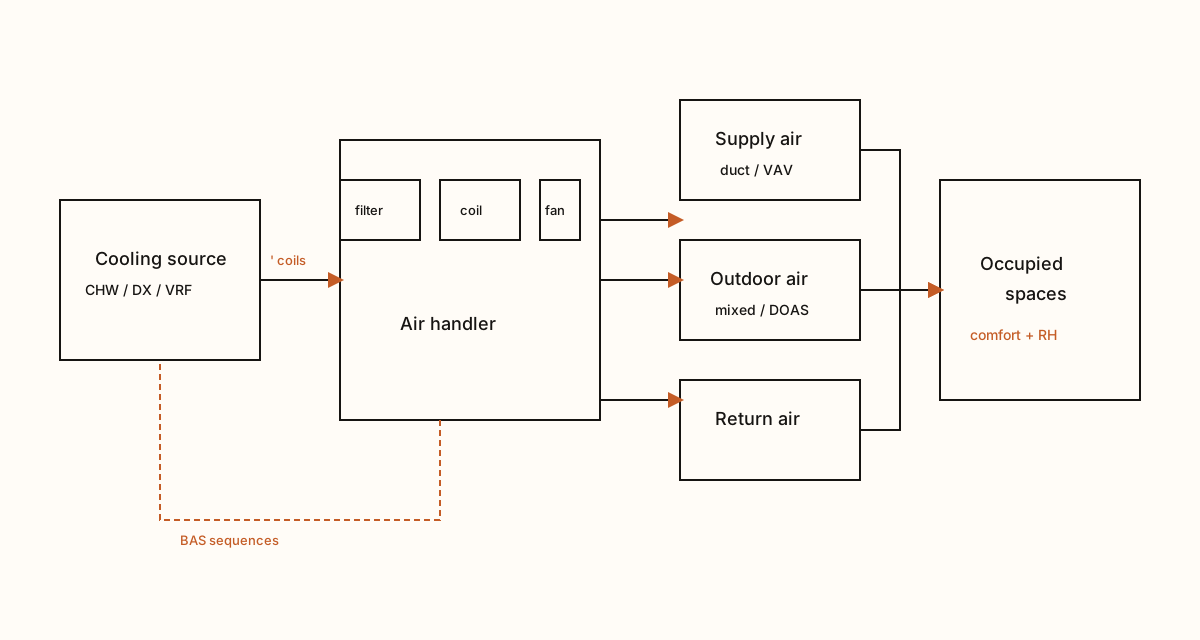
Commercial air conditioning is the engineered cooling of occupied space using coordinated equipment, distribution, controls, and outdoor-air systems. On the Space Coast, it is rarely just a cooling problem. Buildings here carry high latent loads, long cooling seasons, salt-air exposure, and occupancy patterns that range from classrooms and clinics to manufacturing floors and civic facilities. Indian River Mechanical Engineering designs and evaluates air-conditioning systems as part of the whole mechanical plant: cooling source, air handling, ventilation, dehumidification, and automation. The work supports architects, contractors, developers, and facility managers who need systems that can be documented, commissioned, and maintained—not catalog equipment dropped onto a roof.
Overview
What air conditioning engineering is
Air-conditioning engineering for commercial, institutional, and industrial facilities on Florida’s Space Coast, covering system selection, load analysis, distribution design, and integration with ventilation, humidity management, and building automation.
Applications
What we actually do
New construction HVAC design
Load calculations, equipment selection, air distribution, and coordination with architecture and structure for commercial and institutional projects.
Renovations and system replacement
Assessment of existing air-handling equipment, ductwork, and controls, then engineered replacement that fits current codes, occupancy, and energy goals.
Cooling plant integration
Connecting air-side systems to chilled-water plants, DX systems, or heat-pump sources so the building’s cooling strategy is coherent.
Humidity-aware cooling
Sizing and control strategies that address Brevard County’s latent load instead of overcooling occupied space.
Systems
Systems and solutions
Variable-air-volume (VAV) systems
Zoned air systems for offices, healthcare, and education where occupancy and solar loads vary through the day.
Dedicated outdoor air systems (DOAS)
Decoupled ventilation that allows cooling systems to handle space loads while outdoor air is treated separately.
Chilled-water air handlers
Central-plant cooling for larger commercial, healthcare, and institutional buildings.
Packaged and split DX systems
Applied where a central plant is not justified, with attention to humidity, filtration, and control.
Heat-pump and hybrid systems
Including ground-source options where site conditions and energy goals support them.
Buildings
Building types
- Commercial offices and mixed-use
- Healthcare and outpatient facilities
- K-12 and higher education
- Government and civic buildings
- Hospitality and assembly
- Light industrial and aerospace support facilities
Problems
Problems this service solves
Comfort complaints and uneven cooling
Poor zoning, undersized distribution, or control issues that leave some rooms cold and others warm.
High energy use during long cooling seasons
Oversized equipment, simultaneous heating and cooling, or inefficient part-load operation.
Moisture and indoor air quality problems
Systems that cool air but do not remove enough moisture, leading to musty interiors and condensation risk.
End-of-life equipment with no engineering path
Like-for-like replacement that repeats old mistakes instead of matching current occupancy and code.
Engineering
Engineering considerations
- Space Coast cooling loads are dominated by outdoor air, solar gain, and latent moisture—not only interior equipment heat.
- Equipment should be selected for part-load performance; peak-day capacity is only one design point.
- Corrosion, salt air, and hurricane wind criteria affect outdoor equipment location, coatings, and structural attachment.
- Air-conditioning systems must be coordinated with ventilation rates, filtration, and building pressurization.
- Controls sequences determine whether a well-sized system actually dehumidifies and economizes correctly.
Related services
- Heating
Commercial heating engineering for Space Coast buildings that still need reliable heat, reheat, and domestic-related mechanical coordination despite a cooling-dominated climate.
- Ventilation
Commercial ventilation engineering: outdoor air, exhaust, pressurization, and distribution for Brevard County buildings that must bring in humid air without losing control of the interior.
- Humidity Management
Humidity management engineering for commercial buildings in Brevard County’s hot-humid climate, where moisture control is a design problem, not a thermostat setting.
- Chilled Water
Chilled-water system engineering for commercial and institutional cooling plants, distribution, and air-handling on the Space Coast.
- Building Automation
Building automation engineering that connects HVAC equipment, sensors, and sequences so Space Coast facilities operate as designed.
- Indoor Air Quality
Indoor air quality engineering for commercial and institutional buildings: ventilation, filtration, humidity, and contaminant control grounded in mechanical systems—not consumer purifiers.
Locations
This service is available across Brevard County and the Orlando / Central Florida market. Place pages and approved service-location combinations are linked below.
- Air Conditioning context in Melbourne, FL
- Air Conditioning context in Palm Bay, FL
- Air Conditioning context in Viera, FL
- Air Conditioning context in Rockledge, FL
- Air Conditioning context in Cocoa, FL
- Air Conditioning context in Titusville, FL
- Air Conditioning context in Orlando, FL
- Air Conditioning context in Lake Nona, FL
- Air Conditioning context in Lake Mary, FL
- Air Conditioning context in Winter Park, FL
- Air Conditioning context in Winter Garden, FL
- Air Conditioning context in Kissimmee, FL
- Air Conditioning context in Sanford, FL
Questions
Air Conditioning FAQs
What is commercial air-conditioning engineering?
It is the design and evaluation of cooling systems for non-residential buildings, including load analysis, equipment selection, air distribution, ventilation coordination, and controls. It is distinct from residential HVAC installation or repair.
What does a mechanical engineer do on an air-conditioning project?
The engineer defines performance requirements, calculates loads, selects systems, documents drawings and specifications, coordinates with other disciplines, and supports construction administration and commissioning.
When does a building need engineered air conditioning rather than a contractor-only replacement?
When occupancy has changed, when humidity or IAQ is a problem, when the building is institutional or multi-zone, when energy or code compliance is at stake, or when the cooling source is a central plant rather than a single packaged unit.
What types of Brevard County buildings use commercial air-conditioning engineering?
Offices, medical facilities, schools, government buildings, hospitality, and industrial support spaces throughout Melbourne, Palm Bay, Viera, Rockledge, Cocoa, and Titusville.
How does air conditioning interact with other mechanical systems?
Cooling equipment must work with ventilation, humidity control, heating, chilled-water plants, and building automation. Changing one without evaluating the others often creates new comfort or moisture problems.
Discuss your project with an engineer.
Tell us about the building, the system, and the constraint. We will follow up with the right next step—not a sales script.